

Ronda Rousey Opens Up About UFC Losses To Holly Holm & Amanda Nunes
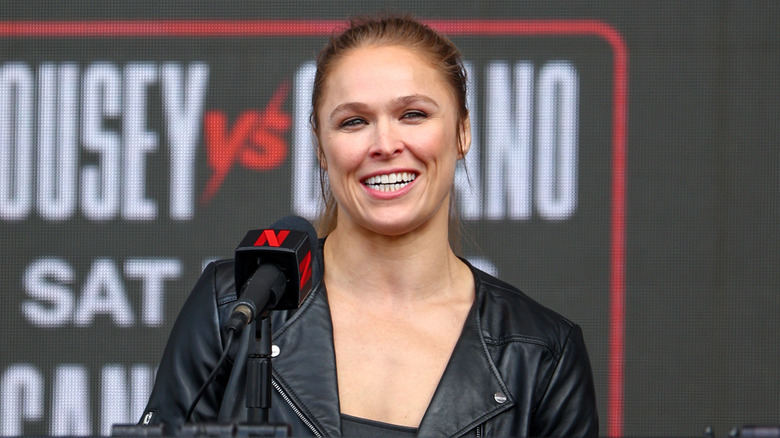
Until the fall of 2015, Ronda Rousey wasn't just the queen of the UFC, she was one of the most famous athletes in all of sports, reigning as the UFC Women's Bantamweight Champion with an unbeaten 12-0 record where all 12 of her wins were finishes. Then in November 2015, she was brutally defeated by Holly Holm at UFC 193 in a loss that would greatly impact her mental health, and when she returned to fight Amanda Nunes at UFC 207, she was beaten even more convincingly and retired from MMA shortly after.
Nearly a decade on from her last UFC fight, Rousey is getting back in the cage to face Gina Carano on May 16 for Most Valuable Promotions' first all-MMA card, but the losses to Holm and Nunes still linger in her mind. Rousey sat down with The Independent recently and opened up about her final year in the UFC, detailing all of issues she was dealing with. "I was having neurological issues, and I was getting hit and basically losing chunks of my vision, depth perception, ability to track moving objects, to think clearly. I thought these were concussion symptoms, because the more concussions I got, the easier it was for me to get these symptoms. So, after my first loss, I was like: 'F***, it's finally caught up to me. I'm never going to be able to compete at the highest level again.'"
Rousey said that there were other factors at play as well, such as having a bad mouthguard in the Holm fight that caused her teeth to be knocked loose. However, she admitted that the Nunes fight was more for everyone else and not for her own personal gain. "I came back again, and again I had to drag myself through it, because I felt like I was expected to come back, and I was coming back for everybody else and not for me. But then the same thing: the first time I got hit, I couldn't see. I just felt like I was forced to retire. There was no way I could safely compete at the highest level anymore."
Ronda Rousey: Everything Was So Result-Orientated
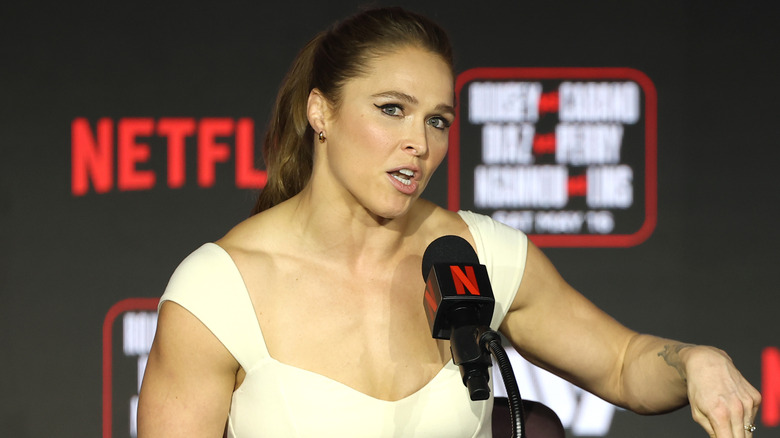
It takes a lot of preparation to get ready for a fight. Weeks of training camp getting prepared for an opponent, the weight cutting, the adrenaline surrounding fight week, everything needs to be considered when judging a performance in the octagon. A good camp can make or break a fighter's chances, but for Ronda Rousey, her fight camps towards the end of her UFC career had become very toxic. "But it was also the toxicity of my training camp. The process wasn't fun anymore, and I was just so over it. Everything was so result-oriented, and I wanted to enjoy the everyday and not just the possible results."
Just over a year after her loss to Amanda Nunes, Rousey would sign with the WWE. However, she didn't want to go public about the negotiations, or even her problems with concussions given WWE's history with concussion protocol. "That's kind of what led me to pro wrestling, but I didn't wanna go public about it, because I didn't want WWE to be like, 'We don't want to work with you,' because of the baggage. They've had bad press from concussions in the past. So, I had to keep it to myself, but that's kind of what forced my hand."
In the end, it was revealed to Rousey that her various symptoms she thought were from repeated concussions were actually something different, and she has UFC President Dana White for helping her discovering the issues. "Fortunately, because Dana sent me to the Cleveland Clinic, we got a diagnosis for what was actually going on with me. They think it's actually migraines, and they got me on preventative migraine medication, and we've been able to test with sparring and see that it works. It's been absolutely life-changing for me."
Rousey knows that the upcoming fight with Carano will likely be her last, but she's hoping that for one last time, she can prove why at one point in time, she was known to many as "The Baddest Woman on the Planet."
Please credit "The Independent" when using quotes from this article, and give a H/T to Wrestling Inc. for the transcription.