

10 Wrestling Moves That Only Make Sense In Wrestling Physics

"Professional wrestling is fake" is one of those statements that, while laced with truth, still rings entirely untrue. Wrestling is comprised of storylines, preordained conflicts, and an in-ring product presented by all involved as a fighting contest. It's fictional, relying on the presentation and story of the battle. Just like many entertainment mediums that hinge on that idea, wrestling requires collaboration to choreograph and safely execute the moves. Dolph Lundgren never really killed Carl Weathers in the "Rocky IV" boxing ring, after all.
Everything from suplexes, punches, and powerbombs are used in wrestling, as one would see them legitimately used in martial arts competitions. Rampage Jackson powerbombed Ricardo Arona in PRIDE, legitimately knocking his opponent out with the move. But that's not the desired outcome when the move is delivered in professional wrestling. It's to look and sound like it hurts, and there is no way to truly mitigate the pain felt from it, so workers collaborate to deliver the move with an equal balance.
If one searches for it, it can be obvious, the occasional jump into a suplex, the occasional roll into the landing zone of a frog splash. While there are also some legitimately dangerous moves that have been banned for the fact they cannot be performed safely enough.
It also works the other way, and there are some moves that just wouldn't be found anywhere else but the performative fighting of pro wrestling. Moves that suspend all notion of believable physics purely for the love of the game. Moves that may look impressive, may have grown into staples of the sport, but cannot work without true cooperation on both sides. And even, in some instances, more work from the person taking the move than the one performing it.
Canadian Destroyer & Code Red
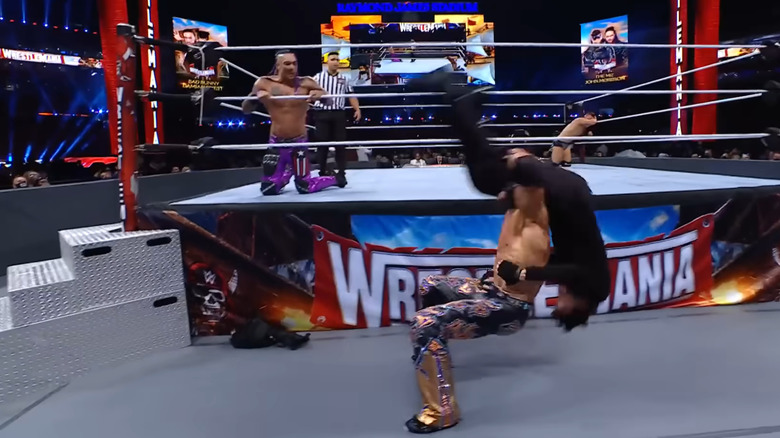
A move that has become very popular over the past decade of wrestling, with everyone from Adam Cole, the Young Bucks, and Penta to Jack Perry, Jimmy Uso, and even Bad Bunny using it, the Destroyer is effectively a flipping piledriver. Many have credited Amazing Red for innovating the move with the help of Quiet Storm, but it was through Petey Williams that the move first garnered notoriety and thus the shared moniker: "Canadian Destroyer."
There have since been variations of the move, with Cole's "Panama Sunrise" a variant delivered from either the middle or top rope, and Teddy Hart even making use of a double-underhook variant during his career. But however it comes, there is simply no battle outside of professional wrestling where this becomes a valid option.
As said, it is a flipping piledriver, and that's not this writer avoiding an expletive but quite literally someone front-flipping, along with their opponent, to hit a piledriver on landing after rotation. And that does not work unless the opponent is willing to go on the ride with them. There is no doubt that the move looks impressive, and almost always draws a pop from the crowd. But that, fortunate or unfortunate depending on one's standing, is all a part of the show.
Much the same can be said for an entirely different, while also quite similar, move in the Code Red. Often used by smaller competitors, such as Roxanne Perez and Zelina Vega, the Code Red sees one jump on the back of their cramped over opponent, once more flipping forward with them in an impromptu sunset flip powerbomb. Again, it's one of those moves that cannot work without someone willing to flip backwards onto their shoulders, and wouldn't be advisable to try in a fight.
Hurricanrana & 619
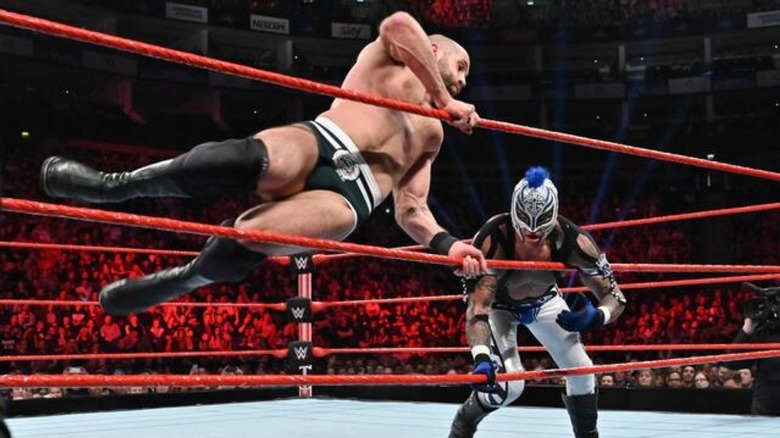
The Hurricanrana is as common as a DDT or a Greco-Roman knuckle lock in today's wrestling, with many of the world's high-flyers adopting the move on numerous occasions throughout singular contests. They work for a quick change of momentum, reversing out of electric chair and powerbomb positions for a spiking impact and oftentimes a quick attempted cover. And again everyone from the likes of Rey Mysterio to Bron Breakker have made the move part of their staple set.
That said, it doesn't change the fact that, yet again, without willing participation from one's opponent, there is no way this move ends well for the person trying it. Wrestling so often exaggerates human momentum for the thrill of watching someone fly across the ring, and that can be observed when someone entirely misses the head-scissors portion of the maneuver, their opponent still flipping as though guided by invisible force.
A recent example of the move's reliance on cooperation came during Survivor Series: WarGames, with Dominik Mysterio trying to perform a hurricanrana to John Cena from the barricade; Cena fell backwards, leaving Mysterio to follow through with the motion and land firmly on his shoulders and neck. But Mysterio, and his father, have also made use of another physically implausible maneuver as their finisher: the 619. The move requires set-up to get one's opponent sprawled against the middle rope, allowing for one to run at said rope, catch themselves and swing into a rotating kick into the sprawled opponent's face. It's the epitome of a staged set up and execution, with ample time for an opponent to move from their position while they lie in wait, but also in its flamboyance sacrificing all real momentum behind the kick.
Tree of Woe & Old School Rope Walk

Heading up the ropes now and, with things getting all the more risky, cooperation becomes all the more important. When one has a bit more energy and their opponent in the position for a powerslam, sometimes that can appear to be too easy. So what else is one to do other than to drape their opponent over the ropes, leaving them to hang there at their mercy.
That would be the Tree of Woe, and it relies on the idea that the worker being draped simply cannot free of themselves from... using their ankles to hang there. It's a transition to a maneuver, either a top-rope foot-stomp to their opponent – willingly hanging there before the drop – or a running dropkick into the corner – where their opponent continues to willingly hang there. In case it is yet clear, it requires one to willingly hang, and if one wants to get out of the move, they would. It became a regular criticism during the time of Alberto Del Rio's switch between the Cross-Armbreaker to the Double Foot Stomp in 2015, with the likes of Kalisto and John Cena very clearly just waiting for him to hit the move.
Speaking of simply waiting for one's opponent to hit the move, the same can very much be said about moves where one walks the ropes with their opponent in a wrist lock. Undertaker notarized the maneuver as Old School, and many luchadors from Mistico to Komander have adopted and adapted the method. But how effective can a move be when it relies on your opponent to keep you upright? It's another example of plainly obvious cooperation for the sake of spectacle, providing no form of tactical advantage or added benefit other than to look cool.
Sling Blade & Sling Shot
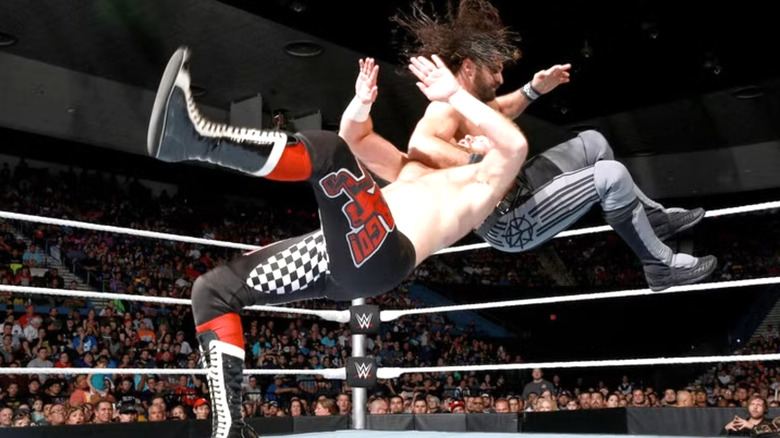
A staple belonging to the likes of Finn Balor and Seth Rollins, the sling blade is another quick momentum-changer to drop one's opponent to the mat with sharp force. It sees the wrestler throws themselves at their opponent, hooking their arm around the neck and rotating. It often either sends an opponent straight to their back on the mat or floor, or in some cases sends their opponent flying back. And while it is, at its core, a running lariat, it's another move that proves nowhere near as effective in actual fact.
For the sling blade to work the opponent has to follow the motion, falling back with the move as the rotation is completed and it looks as though they have been sent to the ground with it. But if the opponent stands their ground, sure they get an upper arm to the throat and that doesn't sound at all pleasant, that rotation movement actually negates any ability to apply pressure enough to drop them. It's the moment a running or diving lariat becomes better looking than effective.
Slinging is generally not something to be done with humans, and like the sling blade there is a sling shot maneuver that demonstrates that idea. Using the logic of a see-saw or catapult, a competitors grabs their opponent by the ankles, falls backward, and launches their opponent across the ring (or whichever battleground they're fighting on). Only, if their opponent was to choose not to fly across the ring, that's not how that would go.There is just simply no way such a motion can generate the force required to launch hundreds of pounds of person in such a way. Doing the move in actuality would yield for an uncomfortable time both for the one doing the move, and the one receiving it.
Spanish Fly & Irish Whip

The Spanish Fly is another move to have become immensely popular and commonplace among wrestlers over the past decade. As one can imagine from the name, it's one commonly found in lucha libre, and it's been delivered off the top ropes, standing in the middle of the ring, on the floor, off announcer's desks, and anywhere two people can realistically stand and flip.
It sees two opponents lock up with their arms across each collarbone, the one delivering the move flipping backwards while the other flips forwards into the flat-back landing and attempted cover attempt from the former. It's cooperative to the core, and when not done quickly comes dangerously close to breaking all forms of immersion. It simply will not work without both working together. And the move has drawn much criticism for its extensive use owing to that fact. But it also shares that collusive trait with another, long-standing and rudimentary move used in effectively every wrestling match in modern history: the Irish Whip.
The Irish Whip is so simple, just grab an opponent by the arm, pull, then push the opponent into the ropes or turnbuckle. The opponent either slams into buckles, goes over, or bounces off the ropes. But it's also just not how momentum works, and requires more than just a little push to become the Irish Whip fans have come to know and accept. Wrestlers run with the Irish Whips all the time, as if guided by an invisible force, but they never have to. It's a choice made for the sake of keeping the match together, and a plot hole that fans collectively choose to take for what it is. Such is the way of professional wrestling.