

WWE's Alexa Bliss Explains How She Overcame Eating Disorder

Growing up as a teenage girl can come with immense pressures, particularly when it comes to body image and self-esteem. WWE star Alexa Bliss knows those struggles first hand, having battled and overcome an eating disorder during her adolescence.
On a recent episode of "What's Your Story," Bliss opened up about her long and winding journey to recovery from anorexia, which began after she heard a comment from one of her male peers.
"I was called 'thunder thighs.' That's such a silly comment for a teenage boy to make," she said. "I was already kind of paranoid of my legs. I was a gymnast. I had great legs. Looking back on them, I was like, dang, I had great legs, but I was muscular and just a little [powerhouse]. Growing up in middle school, high school, and not looking the same, it really got to me for some reason."
Bliss initially reacted to the remark with "simple dieting" aimed at widening the gap between her thighs. That dieting quickly escalated, however, with then-high school cheerleader and gymnast dropping down to 86 pounds due to her lack of eating.
By that point, Bliss noted that her parents had grown increasingly concerned, even begging her to consume food. The 16-year-old Bliss didn't want to, though, as she considered her intake and shape two of the few things she could control.
Her parents eventually took control of the overarching situation by bringing her to the hospital.
"I ended up dropping down to like 86 [pounds]," Bliss recalled. "They told me we were going to church and they were like, 'Oh, we're going to church, but we're just going to swing by here first just to see.' But they knew they were taking me to the hospital. 'Just to make sure you're good.' We show up there. My heart rate was like 28. They told my parents, 'We're gonna be admitting her with or without your consent.' My parents were like, 'No, 100% admit her.'"
Bliss Felt Like A 'Prisoner' In The Hospital
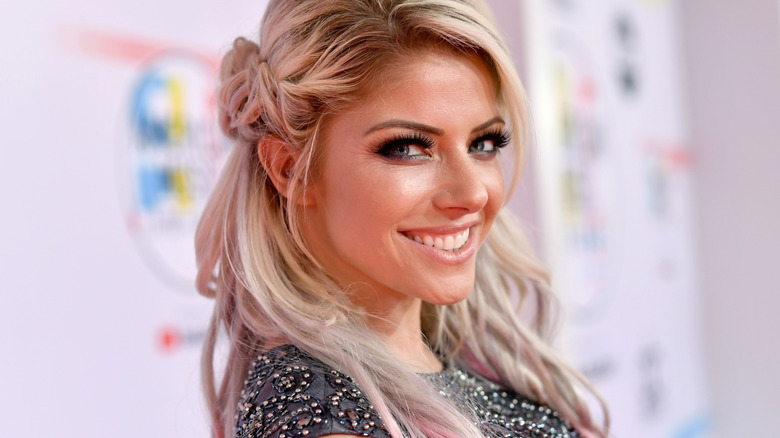
Once inside the hospital, the gravity of her condition suddenly hit Bliss as she asked a doctor if she'd die.
"I didn't think I had a problem. I looked at myself in the mirror and I didn't see the issue," she said. "I thought I could be skinnier. I was like, 'Oh, I could be skinnier. I don't have a problem. Everyone else is the problem. I'm fine.' It was very one, being a stubborn 16-year-old, two, having disorderly eating and mental disorder, I didn't see it until it scared me of the doctor saying, 'Well, we're gonna try our best.'"
At the time, the hospital's eating disorder unit was still fairly new, meaning its staff didn't know how to properly treat Bliss. The WWE star described the experience as one similar to a "prisoner," with doctors and nurses monitoring her consumption, actions, and whereabouts at nearly all times. She wasn't allowed access to books or a phone, either.
Fortunately, Bliss did have a good support system to help her through the hospital stay. That included her friends from high school, those made in the program, and her parents.
With their encouragement, the teenage Bliss gained the weight she needed, and after overcoming additional setbacks related to her heart rate, she was finally released from the hospital and placed into an outpatient program for further treatment.
She Made Meaningful Progress At Disney
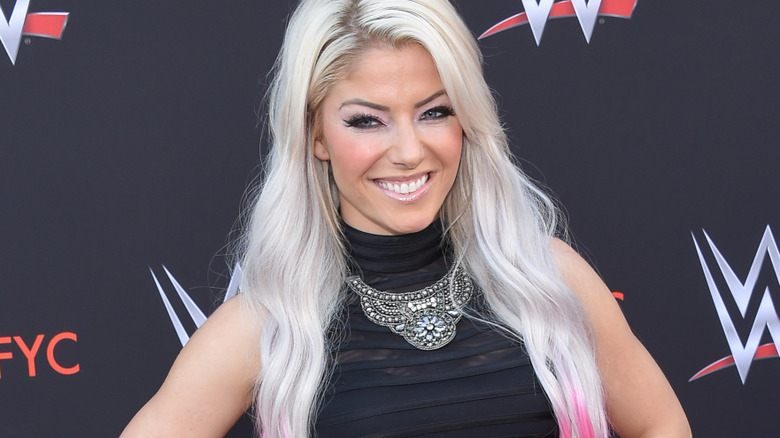
According to Bliss, the outpatient program treatment caused her health to regress, so much so that her mother removed her from it and stopped seeking doctors altogether. The lead staff member overseeing her case was also fired from the care center, which ultimately shut down as well.
Bliss' recovery then took an unexpected yet positive turn as she experienced her first meaningful progress — an eight-pound weight gain — in some time while out on a family trip at Disney.
"My parents took me to Disney. We're just sitting there and all of a sudden I look at her and I go, 'Can I have one of your fries?' And she was not making a thing of it," Bliss said. "She goes, 'Sure.' And so I ate a fry and I go, 'Can I have another?' And she's like, 'Yeah, if that's what you want.' That trip, I gained eight pounds and never looked back until college, but then got better. I think just being away from being told I was sick, being reminded I was sick. And whenever I thought I was getting better, someone was there to remind me that I wasn't."
The progress made during that Disney trip carried Bliss through her remaining high school years, eventually allowing her to graduate and move on to college. College itself proved to be another challenge, however, as competitive cheerleading expectations led to a momentary eating disorder relapse.
A Momentary Relapse

"They made us do these bod pods, where you go in and they measure your body fat percentage," Bliss explained. "They were posted, and then we had to sign into the gym like twice a day. I remember telling [my coach] like, 'Hey, I can't do that. I just got over anorexia last year. I don't feel comfortable.' This is a bad trigger. She was like, 'Well, if you get to this weight, you'd be the only freshman on the Nationals team.' So the competitiveness in me, I just started losing weight. The same thing happened."
Bliss made it clear that her coach's encouragement came from genuine excitement about her potential to earn a spot on the Nationals team. Once she recognized the seriousness of Bliss' concerns and condition, she then attempted to reverse course. By that point, though, Bliss had already fallen back into harmful habits and become "dangerously small."
That's why she took matters into her own hands, beginning with a drive back home and an extensive packing of her belongings. The next day, Bliss then signed herself into the hospital, the same one her parents initially took her to.
Bliss described this experience as a much-improved one, with medical professionals treating her eating disorder as a mental illness, rather than a physical one. "It was a very well established, reformed program," she said, revealing that it connected her with both a psychiatrist and a psychologist.
"I got a lot better after that and then got into bodybuilding, which brought me to WWE," she added.
WWE's Sara Amato Inspired A 'Light Switch' Moment In Bliss
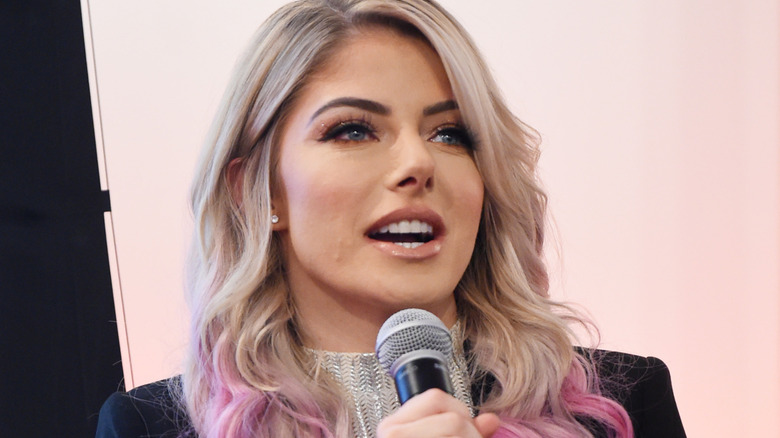
Bliss signed with WWE in 2013 at the age of 21. By 24, she was a world champion. She was also gaining healthy weight, thanks in part to WWE Performance Center coach Sara Amato.
"I remember Sara Amato told me one time I came back from break because we had a break, and I leaned out. That was my obsession at the time, just leaning out. And she was like, 'Hey, you look great, but this is not healthy for here. If you want to be successful here, you need some padding. You will get hurt and you will not make it.' I don't think she ever remembers saying that, but she was like, 'You look great, but you need to bulk up a little bit, but in a healthy way. You need some padding. You need some fat on you.' This is physical business. She just didn't want to see me hurt."
Bliss described that moment as a "light switch" that permanently put her back on a healthy track, not only for the sake of her career, but also herself. Years later, she now hopes to inspire her daughter, Hendrix, and others to be confident in themselves.
Above all, the former WWE Raw Women's Champion stresses that a number on a scale does not determine one's worth, neither do the contents of what one eats. Treating people with kindness is what truly matters to her.
If you need help with an eating disorder, or know someone who is, help is available. Visit the National Eating Disorders Association website or contact NEDA's Live Helpline at 1-800-931-2237. You can also receive 24/7 Crisis Support via text (send NEDA to 741-741).