

Match Spotlight: Bret Hart Vs. Shawn Michaels, WWE WrestleMania XII
In the long history of WWE, 1996 was a pivotal year. After "WCW Nitro" premiered head-to-head against "WWF Raw" (as it was known at the time) the year before, the Monday Night War was in its early stages. The 12th edition of the World Wrestling Federation's WrestleMania took place on March 31, 1996, just a short time before WCW would pull ahead in the ratings for an extended period of time.
As WrestleMania events go, 12 is a middle-of-the-road pick in terms of quality, as it's dominated by a single match. That is the bout we'll be discussing: the main event Iron Man match between WWF Champion Bret Hart and challenger Shawn Michaels. This hour-long battle is not for everyone, but for those with the patience to sit through a full Iron Man match with only one pinfall, it remains a favorite in WrestleMania history. It's also a key part of one of the company's most storied rivalries.
Earlier in 1996, Michaels won the Royal Rumble to earn his shot at Hart, who had held the promotion's top title since he defeated Diesel (AKA Kevin Nash) for it the previous November. The video package preceding the match framed this as a contest to determine the best in the world, after both men steadily climbed the company's ranks over the previous decade through hard work and determination. While Hart was in the midst of his third world title reign, Michaels had yet to win the big belt, which informed the dynamic between the two before the match, during, and in the years to come.
But forget all that for now. First, let's dive into the match itself and break down what makes it a classic.
'The boyhood dream has come true for Shawn Michaels'
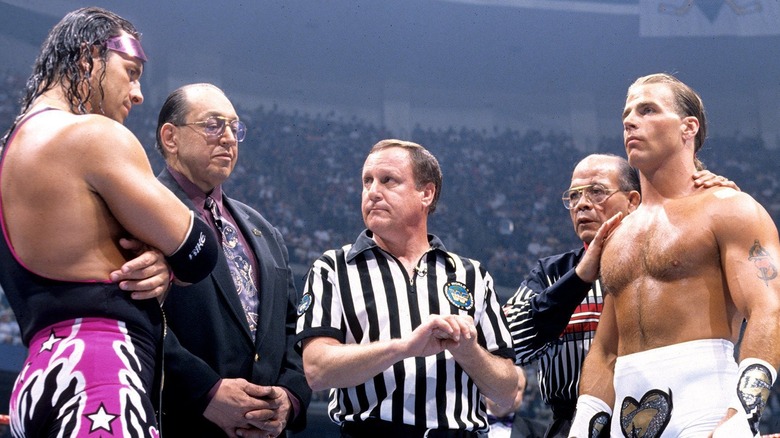
Things kicked off with Michaels arriving via zipline, before Hart made his entrance in more standard fashion, but with the belt around his waist. Earl Hebner, who would later play an even bigger role in the Hart-Michaels story, was the referee here. Although they'd happen every so often at live events, this was WWE's first televised Iron Man match, so Hebner carefully explained the rules before signaling for the bell. As it would turn out, by the way the match was structured, it wasn't too important for fans to follow those rules too carefully.
Over the next methodically-paced hour, Michaels and Hart show off their in-ring acumen, although it's fair to say this is neither man's best work. The match could have a stronger through-line, but Vince McMahon and Jerry Lawler do a fair job (mostly) of explaining the story as things slowly escalate.
The match begins with technical wrestling, which is supposed to be Hart's speciality. However, it's Michaels who maintains most of the advantage at first. As things progressed, the wrestlers integrated more brawling elements, with Hart ratcheting up the violence compared to his usual demeanor. As the performers alternated between styles of wrestling, they steadily quickened the pace, with Hart establishing himself as the heel so Michaels had more to gain out of the eventual conclusion.
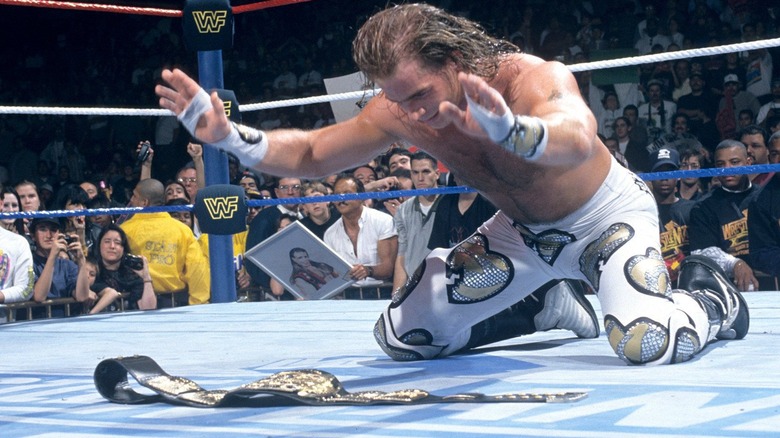
Despite its length, the match is never boring, which is a credit to Hart and Michaels. When they finally get to the home stretch, the crowd is still fully invested, which wasn't a given considering the risks inherent with an Iron Man match. In the end, they reached the time limit while Hart had Michaels in the Sharpshooter, with authority figure Gorilla Monsoon appearing and telling both men to get back in the ring for a sudden death finale. Michaels then hit Hart with two Sweet Chin Music superkicks and pinned him to win the WWF World Heavyweight Championship, with McMahon calling out Michaels' "boyhood dream" on commentary.
A history-making main event
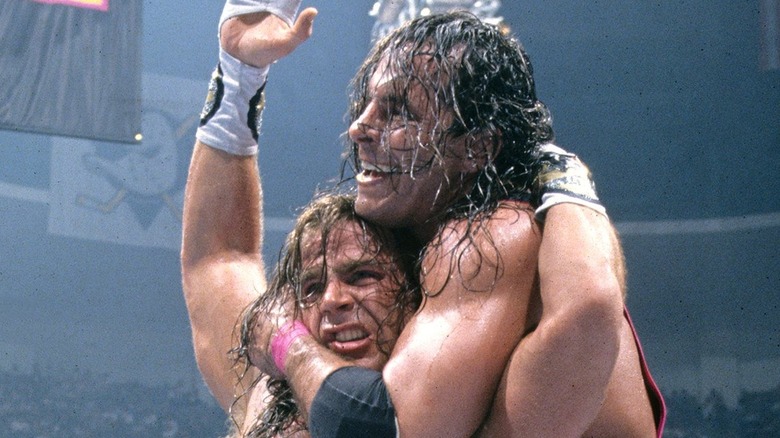
There are various reasons why this match remains an important part of WWE's history, and the legacy of both Hart and Michaels. A big part of it is that it served as Michaels' final step into the world title scene. While he's undeniably an instrumental figure in WWE history, Michaels only captured a world title four times, making each one matter a little bit more than someone like John Cena.
Along that same line, the match served as a torch-passing moment. In many ways, it was the beginning of the end of Hart's time as a top babyface in the company. He took a significant amount of time off after this match, and when he returned, his character had become more complicated. At the following WrestleMania, he'd become a full-blown heel (at least to American viewers).
That finally brings us to perhaps the elephant in the room: the real-life animosity between Hart and Michaels, and its eventual culmination with the Montreal Screwjob. By all accounts, at the time of their Iron Man match, things had yet to curdle between the two. It was only later on that they'd grow to resent each other backstage, leading to Michaels playing an important role in Hart's explosive exit in November 1997.
As I mentioned earlier, this Iron Man bout isn't the best match Hart or Michaels ever had, and in terms of sheer excitement, their later Survivor Series exchange might take the cake. However, I've always had a fondness for this one, as it shows WWE going out on a rare limb by experimenting in the WrestleMania main event. For all these reasons, it has earned its place as one of the most important matches in WrestleMania history.