

The Nacho Libre Luchador Who Tragically Passed Away In The Ring
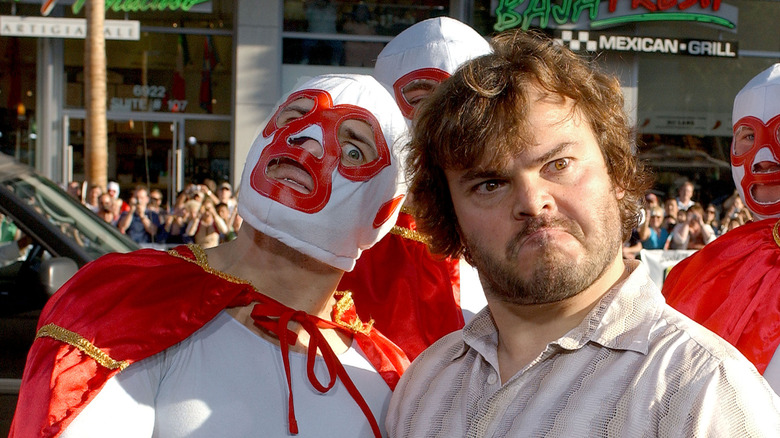
In the world of lucha libre, the 2006 comedy film "Nacho Libre" is a curious case. In part because it's a comedy and in part because it was an American film made for American audiences, it is a very unserious look into lucha, and one that many fans didn't even see as the film performed only modestly at the box office to tepid reviews. But for all its flaws and all its stereotypes, "Nacho Libre" had some very sincere connections to lucha. It's story was loosely based on Fray Tormenta, a Mexican catholic priest who became a luchador in order to fund the orphanage he ran, and the kayfabe mentor of current CMLL top star and lucha libre legend Mistico. And the film's villain, Ramses, one of the few roles in the film to be played by an actual luchador.
Despite being a wrestling film, "Nacho Libre" has very few actual wrestlers in it, so few that you can count them on one hand. There was Mascarita Dorada, who has gained fame wrestling for CMLL, AAA, and WWE (as El Torito) over his career. There was the Human Torando, a mid-2000's independent wrestling star who worked in Ring of Honor, Wrestling Society X and Pro Wrestling Guerilla, where he won the PWG World Championship twice. And then there's the man that played Ramses, Silver King. For most modern day fans, Silver King is known for two things; playing Ramses in "Nacho Libre" and his tragic in-ring death on May 11, 2019, when he suffered a heart attack while wrestling Juventud Guerrera in a match in London. But the luchador was so much more than his movie role and his tragic demise, and a strong argument exists that Silver King was one of, if not the best luchadors of a generation that included the likes of Guerrera, Psicosis, LA Park, and Rey Mysterio.
Silver King Was One Of The Most Successful Luchadores Of The 1990s

Like many luchadores, Silver King, born César Cuauhtémoc González Barrón on January 9, 1968, came from a lucha libre family. His father, Dr. Wagner, was an early lucha libre legend, his older brother, Dr. Wagner Jr., was one of the biggest lucha stars of the 90s, 2000s, and 2010s, and his nephews, El Hijo de Dr. Wagner and Galeno del Mal, have achieved success wrestling in Japan, Mexico, and now the WWE owned AAA. But though he sometimes went under the Wagner name himself, Silver King ultimately forged his own path, starting when he debuted as a 17 year old in November 1985. By 19 years old, he had feuded with El Hijo de Santo, who took Silver's mask in November 1987. By 25, he was part of one of the best tag teams in Mexico with El Texano called Los Cowboys. By 30, he had toured Japan and was wrestling regularly in the United States for WCW as one of the many high caliber luchadores WCW employed at the time.
Silver King had slowed down by the time of his tragic passing, largely because there was nothing left to accomplish; he had won championships in promotions such as AAA, All Japan Pro Wrestling, CMLL, the International Wrestling Association of Japan, IWRG, UWA, and WWA. He became the third wrestler in history to take on the Black Tiger persona, following Marc Rocco and occasional rival Eddie Guerrero. He caused controversy in Mexico when he chose to start wearing his mask again, forcing him to change his name to Silver Cain to avoid serious issues with Mexico's lucha libre commissions. And though, like many WCW luchadors, he was never pushed past a lower card level, footage of his matches with Mysterio, the late Hector Garza, Guerrero, Guerrera, Park and others gives fans a glimpse of the great performer Silver King was. To the less informed, he'll forever be known for standing across the ring from Jack Black. But those who remember know Silver King was more than just another movie villain.